DANIEL PATRICK MOYNIHAN, 50 YEARS AGO...A FIGHTING IRISHMAN stands with ISRAEL at the UNITED NATIONS
50 years have passed since November 10th, 1975, when the United Nations ratified Resolution 3379 declaring "Zionism is racism and a form of racial discrimination." I am forever haunted by the memory of that night, for it was the 37th anniversary of Kristallnacht, "The Night of the Crystals" - the night when Nazi storm troopers torched the synagogues and Jewish holy books in all German cities, smashed windows of Jewish businesses, arrested thousands of Jewish citizens who would perish in concentration camps and gas chambers. "It was" said Israeli Amb. to the UN Chaim Herzog, "the night that led to the most terrifying holocaust in the history of man."
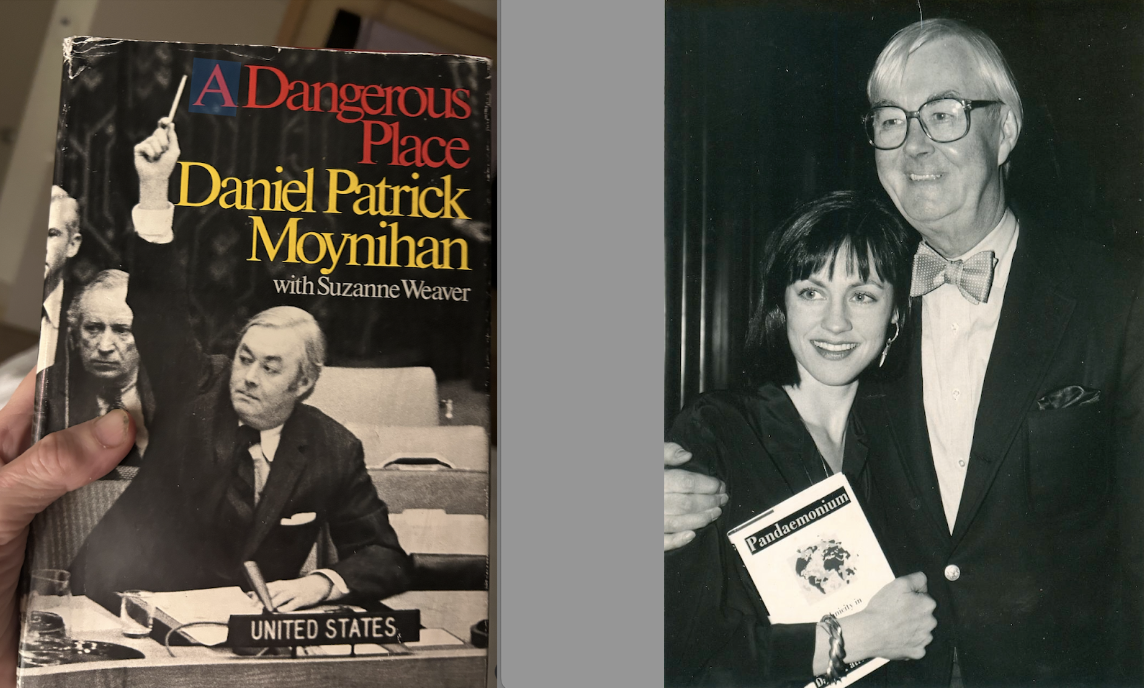
I opened my father's book "A Dangerous Place" about his 8 months at the United Nations, where he defied UN General Secretary Kurt Waldheim and stood with Israeli Amb. to the UN Chaim Herzog in defense of Israel, Judaism, democracy and human rights. Doug Schoen, Moynihan's friend, pollster and biographer, said: "Pat Moynihan framed the current debate on anti-Semitism 50 years ago that cements his legacy as one of the most profound thinkers of the 20th century, indeed of any era. The fights Pat Moynihan fought 50 years ago are the same we are fighting today."
"When America was down - one man stood up" writes Prof. Gil Troy in his meticulously researched book “Moynihan’s Moment" about Moynihan at the UN.
https://giltroy.com/book/moynihans-moment-americas-fight-against-zionism-as-racism/
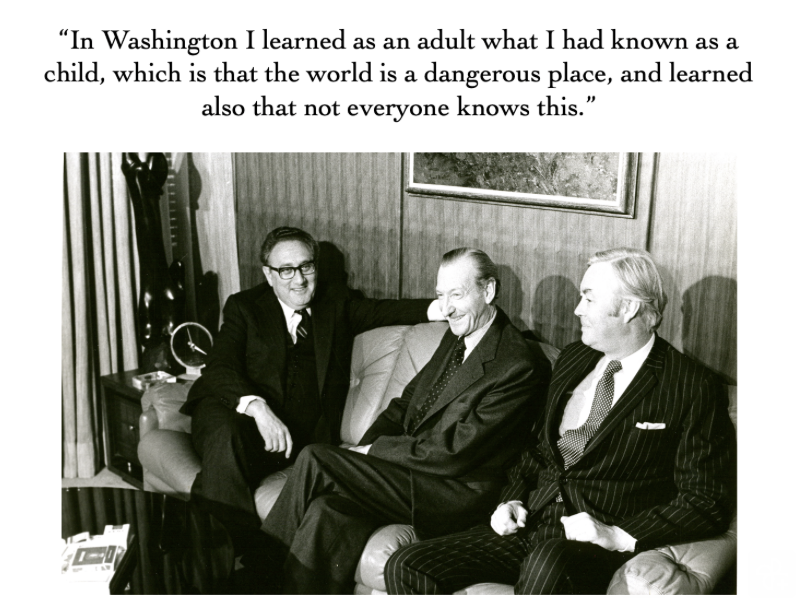
Daniel Patrick Moynihan (1927-2003), scholar, professor, diplomat and politician, is the only individual in US history to serve, in succession, four presidential cabinets: Kennedy, Johnson, Nixon, and Ford. Moynihan was appointed US ambassador to India 1973-5, and the United Nations 1975-6, and was elected Senator from New York from 1976 to 2000.
Known to his friends as Pat, he was raised in New York City by a single mother during the depression. Pat graduated first in his class from Benjamin Franklin High School, enlisted in the Navy in 1944, completed his BA, MA and PhD at Tufts, won a Fulbright fellowship to the London School of Economics, spent three years in England as an assistant to the US Air Force. In 1955 Pat served as an aide to NY Governor Averell Harriman, where he met and married my mother, Liz. In 1961 we moved to Washington to join the Kennedy Administration. When the young president was murdered, Pat lamented; "I don't suppose there's any point in being Irish if you don't know the world will break your heart eventually, but we thought we had a little more time."
Pat left Washington and became a tenured professor at Harvard but would soon return to government in a different role: Ambassador to India and the United Nations.
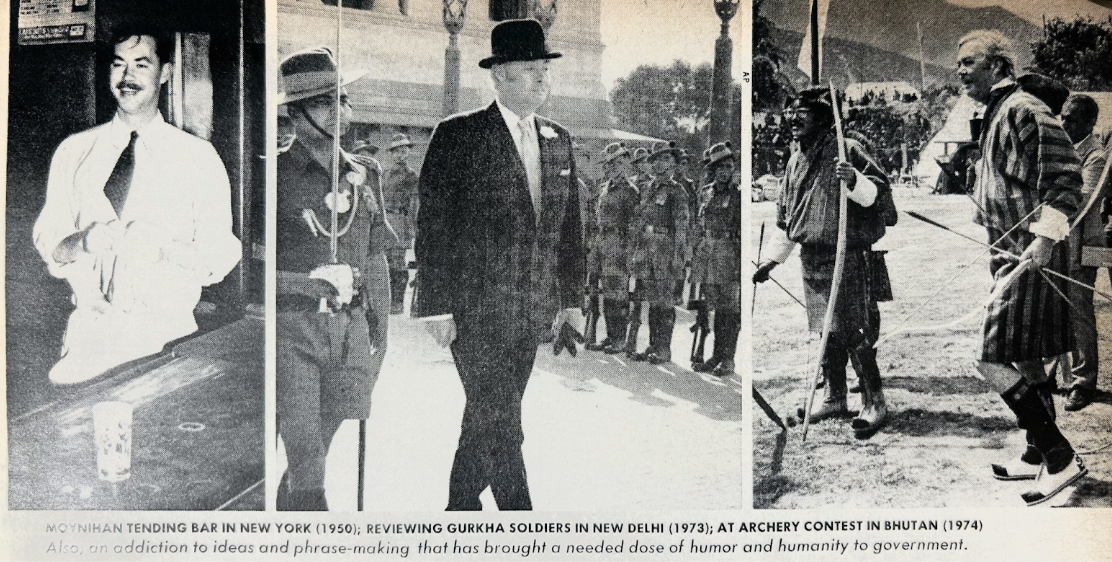
PAT - AMBASSADOR TO INDIA
In 1973 President Nixon appoints Pat US ambassador to India. Pat succeeds in passing the historic “Rupee Deal” wherein he settles a long-standing debt between the two nations and enters the Guiness Book of World Records for writing the world’s largest check to Indira Gandhi. But India is also dangerous place: Liz is warned by the Egyptian Ambassador that a PLO has sent a hit squad to New Delhi to assassinate Pat, to derail Mideast Peace talks. Nonetheless, Liz insists on hosting the annual Christmas party at the embassy, despite the State Dept. pleas to cancel, and Indian intelligence officers capture the PLO agents.
February 1975. The Moynihan family bids farewell to New Delhi with love and gratitude for the friendships and adventures that changed our lives forever. Pat resumes teaching at Harvard. Norman Podhoretz commissions Pat to write an article for Commentary Magazine, entitled “The United States in Opposition” warning that the US must learn how to be in opposition when dealing with the Third World.
https://www.commentary.org/articles/daniel-moynihan/the-united-states-in-opposition/
“Socialist doctrine as it developed in Britain was that it was anti-American. More anti-American, surely, than it was ever anti-Soviet. International life was thought to operate in Wordsworth’s terms: 'The good old rule, the simple plan, that they should take who have the power, and they should keep who can.' So, in their own terms might Marxists judge the aftermath of Marxist triumph: history was working its ineluctable way. “These days,” a Chinese statement continued, “the United Nations often takes on the appearance of an international court with the Third World pressing the charges and conducting the trial.” A statement to which many could subscribe. But no such statement could come from an American statesman, no such praise would be accorded American policy. Clearly at some level—we all but started the United Nations—there has been a massive failure of American diplomacy.
"Here an act of historical faith is required: what is the record? The record was stated most succinctly by an Israeli socialist who told William F. Buckley, Jr. that those nations which have put liberty ahead of equality have ended up doing better by equality than those with the reverse priority. This is so, and being so, it is something to be shouted to the heavens in the years now upon us. This is our case. We are of the liberty party, and it might surprise us what energies might be released were we to unfurl those banners.”
The article gains national attention. Pat appears on the Today Show and holds several press conferences but writes; “I found this distracting. I had written the paper at the end of a period in my life, and to close it down. Then one afternoon the Secretary of State (Henry Kissinger), called to say he had read it through at one sitting and it was ‘staggeringly good.’ Pat’s article is taken seriously enough in Moscow to be translated for the Communist Party Central Committee.
March 26, 1975. Kissinger invites Moynihan to his office in Washington, saying: “On your knees Moynihan” as Pat enters. Pat observes that Henry is not smiling when he issues his command. Kissinger asks Moynihan to take the UN job, which Pat had previously turned down. Pat asks for some time to consider the post.
Pat gives a lecture at the University of Chicago, entitled “On Presenting the American Case” where he states, “There is 1945, was a world in ruins – or, in the case of colonial nations, still in fetters. Only the Western hemisphere escaped, and we stood astride it. All was humiliation save for us. How could we not be detested?” Saul Bellow and Father Andrew Greeley attend Pat’s lecture and urge him to “speak up for us at the UN.”

April 12, 1975. Pat has lunch with President Ford in the White House and accepts the UN post. Ford is pleased and Pat is inspired. He flies back to New York, and gives a speech at Freedom House entitled “How Much Does Freedom Matter?” He quotes John F. Kennedy’s inaugural speech, asking; We shall pay any price, bear any burden, meet any hardship…Would we still? Does democracy, other than American democracy, much matter to us anymore?”
May 3, 1975. The New York Times’ UN reporter, Kathleen Teltsch, interviews Pat at the US mission to the UN. She tells Pat how the UN Human Right Commission had censured Israel for torturing Arabs. Pat replies that the commission is “packed with dictatorships whose jails are filled with their own people. We should rip the hides off of everybody who presumes to talk about prisoners.” Pat then tells Ms. Teltsch that he met the President of the General Assembly, Mr. Bouteflika of Algeria, to ask about the health of Ahmed Ben Bella, founder of the Algerian nation, “rotting in an Algerian jail.”
The NY Times headline reads: “Moynihan Calls on US to Start ‘Raising Hell’ in the UN.” Moynihan cables the White House to say “I MUST WITHDRAW. I WON’T TAKE THE JOB.” Ford refuses to accept Pat’s withdrawal. Pat defers to the president and stays on. Pat asks his friend Len Garment if he will come to the UN; “if you go with me then I’ll do it.” Len agrees. Pat gets two other friends to join his team at the UN: his former Harvard student Suzanne Weaver, and Clarence Mitchell of the NAACP.
June 30t, 1975. At a ceremony in the Rose Garden of the White House, Pat is sworn in as Ambassador to the UN. That evening, the AFL-CIO hosts a dinner for Alexsandr Solzhenitsyn It is the event of the year; the Russian dissidents’ first public appearance in the US. Solzhenitsyn speaks passionately, in Russian with a translator, about how the Soviet Communists betrayed their people. George Meany then addresses the crowd; “We need echoes of his voice in the universities and in the media, and if you please, Mr. Moynihan, in the United Nations.”
July 4th, 1975. Pat has his first breakfast meeting with UN Secretary General Kurt Waldheim, an Austrian politician who has ascended to the head of the UN whilst concealing his Nazi past. Waldheim’s role in the slaughter of Greek Jews and Yugoslavian civilians will surface 10 year later, when he becomes president of Austria.
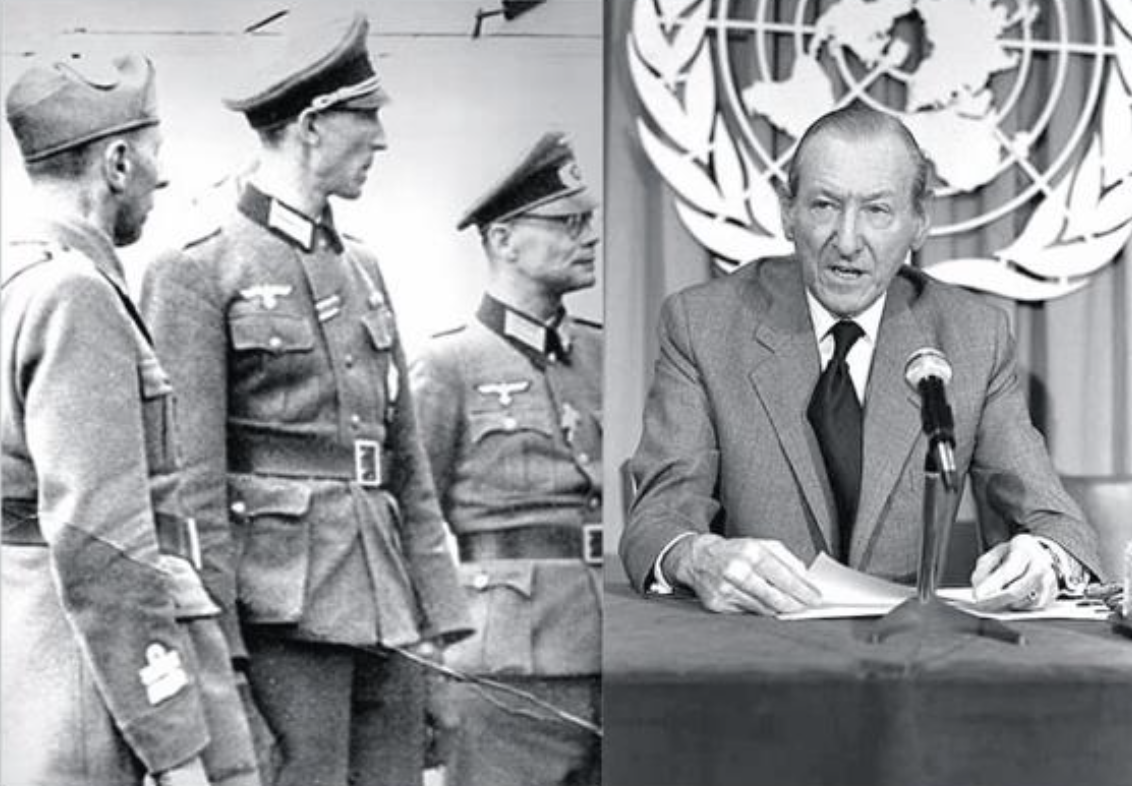
Pat and Len's joke of the century; "What's Waldheimer's Disease?" Forgetting you were a Nazi."
Waldheim tells Pat that the Africans do not understand the demands of his time, that the Chinese by contrast “have been civilized for centuries” etc. and so on. Pat then makes a quick trip to UN Headquarters in Geneva, takes the measure of the UN bureaucrats and dines with the Aga Khan. Kissinger arrives in Geneva, furious with Pat for attending the Solzhenitsyn dinner in May, an event which Kissinger purposefully declined to attend.
July 9, 1975. Back in New York, Pat receives a cable from Barbara White of the US Mission to the UN, from Mexico City with the International Women’s Year Conference. The cable reads: “There were a half dozen strictly political resolutions (on such subjects as Chile, Palestine, Panama Canal)…our ‘no’ vote was based on unacceptable references to Zionism…While regrettable that the ‘No’ vote was necessary, and particularly unfortunate that we were insolated company only with Israel, I do not consider it of great importance to the outcome of the conference as the US achieved its principle objective.” Amb. White's cable sends Pat hunting for the quote from Disraeli's novel "Contarini Fleming" for his cable to White, to ask how, if the resolution was so uninspiring, had we voted against it? "Few ideas are correct ones, and which they are none can tell, but with words we govern men."
Diplomats at the US mission to the UN in New York are puzzled by Pat’s cable. Pat explains to Len Garment that he sees a pattern of the totalitarian state at work; “A formal declaration of a UN conference had called for the elimination of ‘Zionism’ which at the very least entailed the destruction of the state of Israel, but this evidently made no impression on the Americans present.”
July 15, 1975. Pat holds his first staff meeting at the US mission to the UN. He is alarmed when details of the meeting are reported in the press, “something that would have been unthinkable in New Delhi.” Columnist William R. Frye writes: “More eyebrows were lifted than in the Elizabeth Arden beauty salon on New York’s Fifth Avenue…it was the Commentary article plus 4000, one astonished staffer remarked later.”
Pat presents his credentials to Secretary General Waldheim, and then holds his first press conference with the large UN press corps. When asked what would be US policy, Pat replies: “Cet animal est tres mechant, quand on l’attaque il se defend; the animal is very cruel: when attacked, it defends itself.”
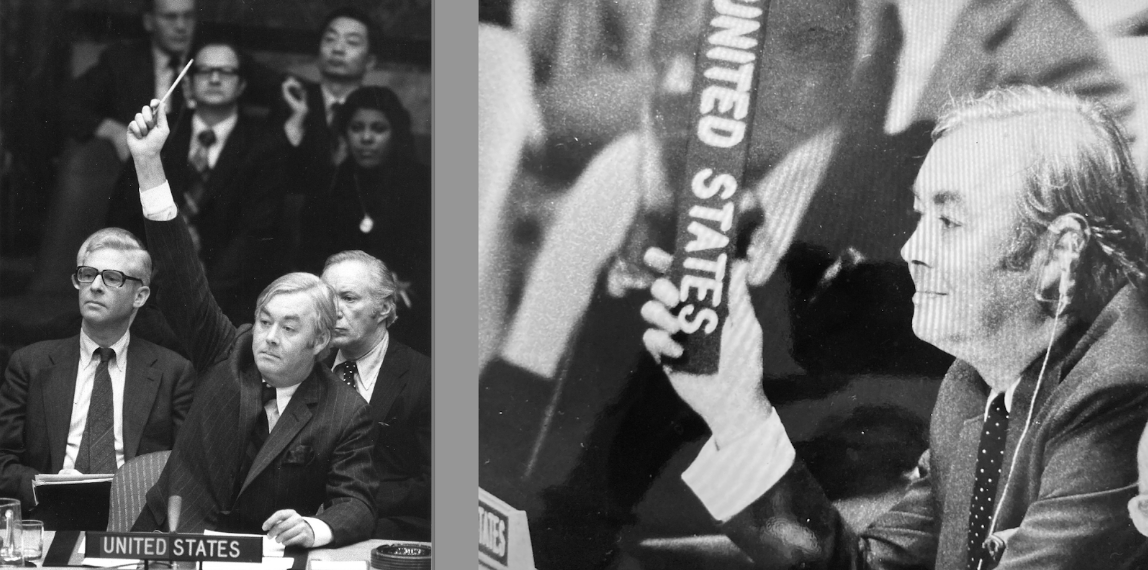
Pat tells Len and Suzi he is not looking for a fight, but won’t back off from one, and “might even relish one if someone else chose to start it.” However, the State Department believes that their only mission is to “work out the problems of co-existence.” Pat and his team are concerned that in 1975 there is a startling decline in US public support for the UN, only 28% of the public thought the UN played a “very important role.”
Pat, Len, Suzi and Clarence Mitchell have an idea; they will make human rights the theme of the next general assembly. They draft recommendations to the UN Mission, which include creating a human rights ambassador. State Dept. officials are puzzled, but President Ford approves.
Pat and Liz host a reception for the US congressional delegation and UN ambassadors at the residence at the Waldorf Astoria Hotel. Liz suspects that her Polish maid isn’t just a maid. She asks Pat’s chief aide Joe Meresman to investigate. Joe produces photos of the maid's a luxurious lifestyle behind the Iron Curtain, provided by the KGB.
September 16, 1975. The 13th General Assembly commences at the UN. Pat and Len sit through a series of speeches, of which Pat quips “some are worse than others.” Back at the mission, Pat, Clarence, Suzi and Len receive a limp 4-page memo from the State Department, asking Pat not to speak about anything except “the principle of universality.” Pat ruefully notes that US Foreign policy elites are “decent people, utterly unprepared for their work…their common denominator, apart from an incapacity to deal with ideas, was a fear of making a scene, a form of good manners that is a kind of substitute for ideas.”
Every evening, after work, Pat heads to the bar of the Delegates Lounge “beckoning at random a moment to whichever Non-Aligned Ambassador hove into view.”
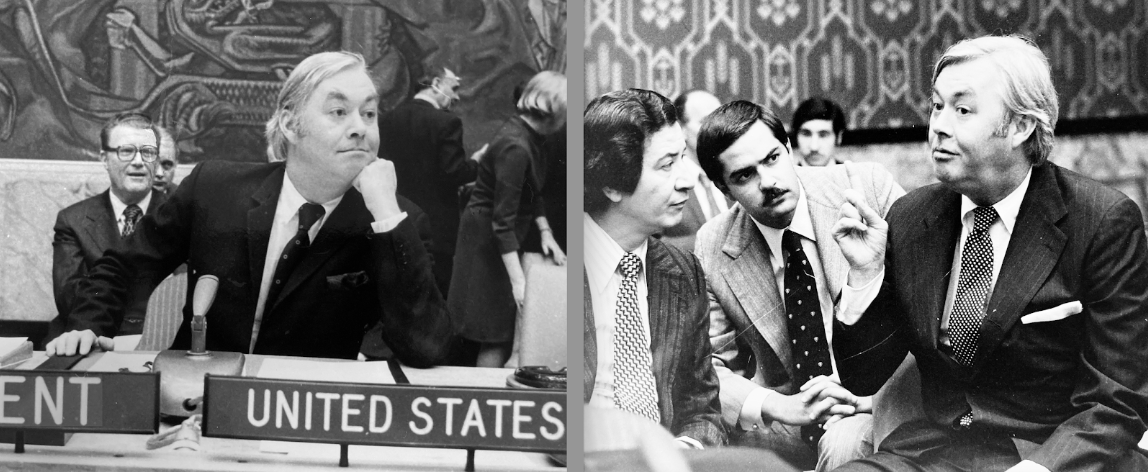
Throughout the month of September there is “a glut of dining, with Kissinger in and out of New York, staying when in town at the Presidential Suite at the Waldorf.” But when the 30th General Assembly begins – Pat calls it “The Foreign Ministers Fair” – the trouble begins.
October 1, 1975. Field Marshal Al Hadji Idi Amin Dada, President of the Republic of Uganda and presiding chairman of the Organization of African Unity, arrives in New York and addresses the General Assembly. Pat chooses not to attend in person, instead, he listens on a radio hookup in his office. Amin proclaims, “The United States of America has been colonized by Zionists who hold all the tools of development and power…I call for the expulsion of Israel from the United Nations and the extinction of Israel as a State.”
Amin gets a standing ovation. The following day at a press conference Amin says that New York City is bankrupt “because the United States must send arms to Israel to murder the Arabs.” Pat is instructed by Kissinger to attend Kurt Waldheim’s dinner for Amin, but Pat does want to break bread with the Ugandan dictator. He boycotts the Waldheim dinner and denounces Idi Amin.
In September 1972, Amin sent a telegram to Kurt Waldheim, copies of which went to Yasser Arafat and Golda Meir. In the telegram, Amin "applauded the massacre of the Israeli Olympic athletes in Munich and said Germany was the most appropriate locale for this because it was where Hitler burned more than six million Jews." Amin also called "to expel Israel from the United Nations and to send all the Israelis to Britain, which bore the guilt for creating the Jewish state." Despite international protests, the UN spokesman, Waldheim said in his daily press conference “it is not the secretary-general's practice to comment on telegrams sent him by heads of government.”
Pat believes that Amin’s purpose is to equate Israel with everything the world community deplores and to equate the United States with Israel. Pat tells Len; “it is time to create a crisis.” Len tells Pat that a resolution had been introduced into the Third Committee declaring “Zionism is a form of racism and racial discrimination.” Pat replies: “something is going to happen – the Non-Aligned and the Soviet blocs are reinforcing one another in a generalized assault on the democracies and a specific assault on Israel.”
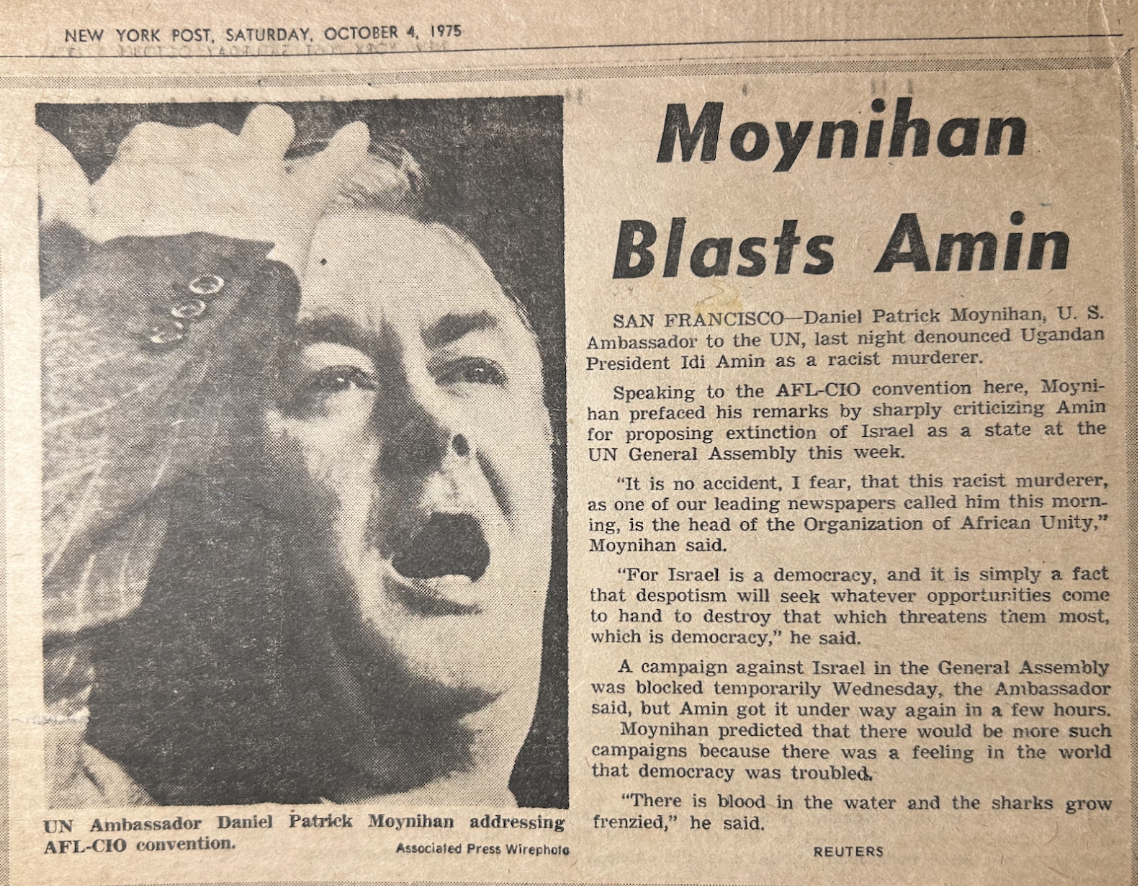
October 3rd, 1975. Pat flies to San Francisco to speak at the AFL-CIO convention, sharing the dais with George Meany, who hosted Solzhenitsyn in May. Pat rises to the podium and speaks:
“In his statement yesterday, George Meany said that democracy has come under attack. I see it every day at the United Nations. It is no accident that on Wednesday His Excellency Field Marshal Al Hadji Amin Dada, President of the Republic of Uganda, called for the ‘extinction of Israel as a state.’ And it is no accident, I fear, that this ‘racist murderer’ – as one of our leading newspapers called him this morning – for Israel is a democracy and it is simply the fact that despotisms will seek whatever opportunities come to hand to destroy that which threatens them most, which is democracy. At the very moment in New York, Mr. Leonard Garment, Counsel to the US Delegation, is fighting back the latest such move, which equates ‘Zionism’ with ‘racism’ calling for the eradication of both. There will be more campaigns. They will not abate, because it is sensed in the world that democracy is in trouble. There is blood in the water and the sharks grow frenzied. They commence, of course, to consume each other and the chaos mounts.”
Headlines read “Moynihan Assails Uganda President, Delegate to the UN Endorses Description of Amin as ‘Racist Murderer’ - Moynihan Criticism of Amin Has People Buzzing – Africans and Arabs Denounce Moynihan at the UN” Pat tells Liz; “There are morals to be drawn from this. The first is to avoid writing speeches in airplanes. Another, translated from the Gaelic, is that if you want an audience, start a fight.”
The career officers at the US State Department are upset. The UN staff prepares an apologetic press release, writing that Pat was told to explain that “some of Amin’s statements before the General Assembly earned wide approval: others were morally offensive.” Pat tells the State Dept. staff; “not one goddamn thing Amin had said had won my ‘wide approval.’”
The State Department issues a press release about Pat and Idi Amin, stating: “Ambassador Moynihan’s words were his own.” Pat tells the press “I don’t understand the confusion; you call a racist murderer a racist murderer and people are confused? We are not here to hear totalitarian dictators lecture us on how to run a democracy.”
When Pat is attacked by various delegates in the General Assembly, Clarence Mitchell asks why no one mentioned the recent report of the International Commission of Jurists about Amin’s record of slaughtering and torturing the people of Uganda.
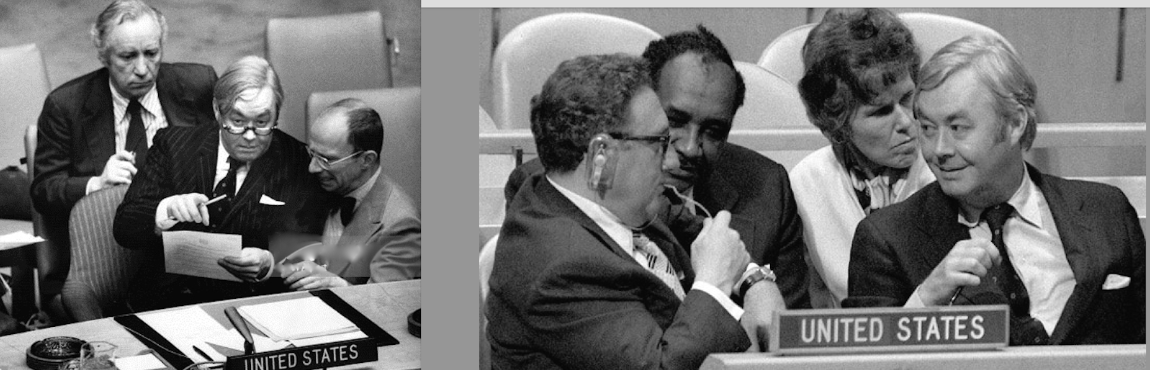
Pat and Len Garment in combat with the General Assembly, and Kissinger
In the Oval Office, Kissinger complains to Ford about “this Moynihan thing” and asks Ford to say something at his press conference that night “to set it straight.” Ford declines to do Henry’s bidding, and at the next Cabinet meeting tells Pat: “You seem to be surviving.” Pat replies: “If you say so, then I am.”
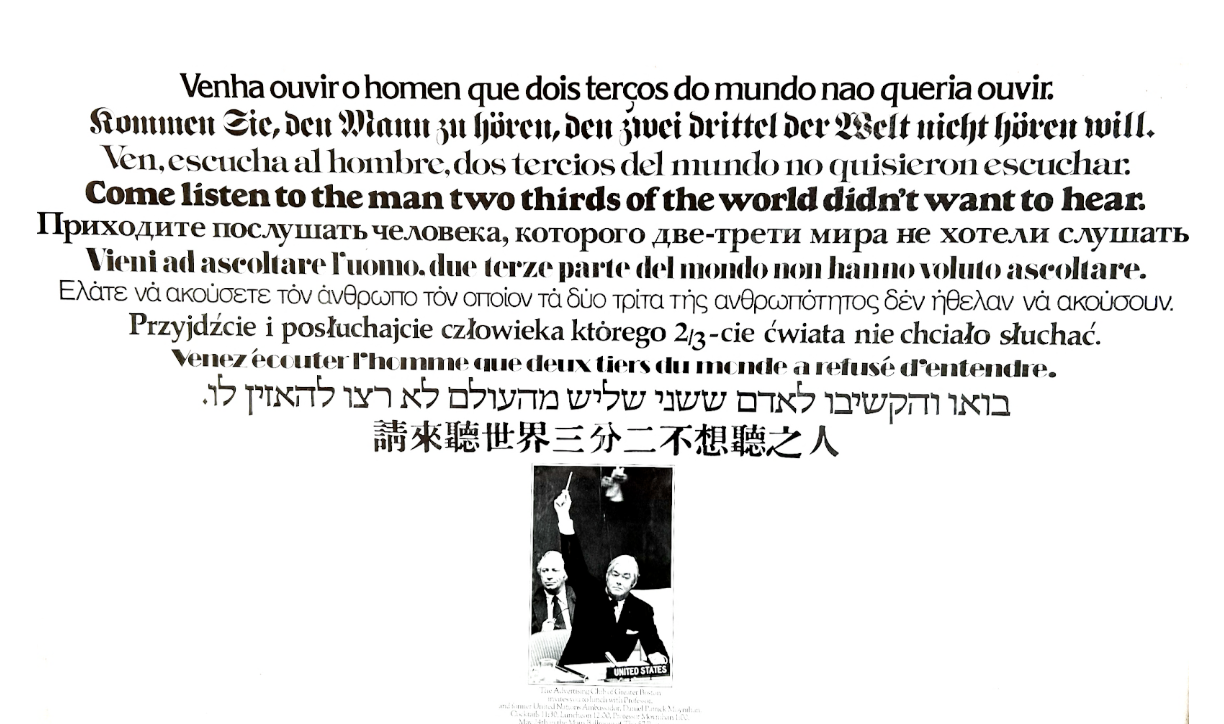
Thousands of letters of support for Pat and his team arrive each week at the US mission to the UN. Of the many tributes he received, one that came as a surprise; Ambassador Moynihan is named to Mr. Blackwill’s 1975 Best Dressed List. Pat had a distinctive style of dress, English suits and silk bow ties, but he was fond of old corduroy trousers and frayed cardigans with leather elbow patches. Pat also receives a medal from the Irish Hatmakers Association for popularizing the tweed hat in which he was daily photographed.
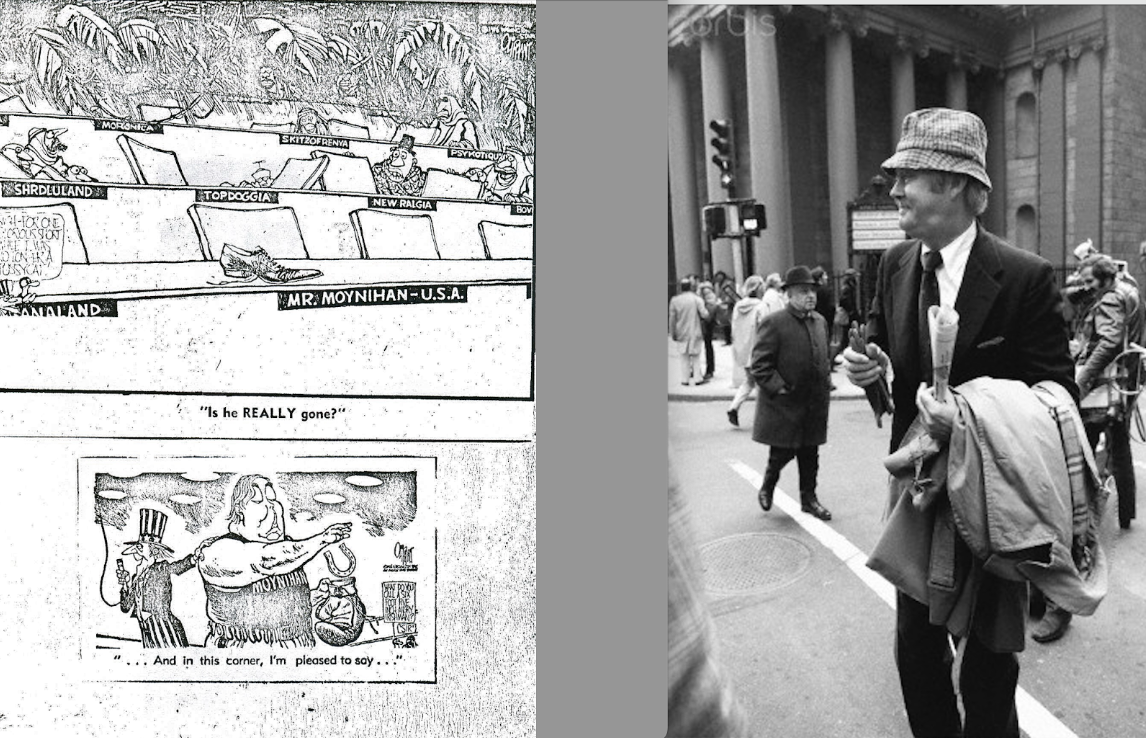
Resolution 3379, which Len Garment first spotted in the Third committee, advances towards the General Assembly. Pat writes: “This was Garment at the top of his form. Listening, Reasoned. A counselor. But it was not the Jews that were in my mind as the crisis of the Thirtieth Assembly took form, nor yet Israel. Not the accused at all, but the accusers. For it came to me early in the proceedings, that the charge against Zionism somehow emanated from Moscow. It reeked of the totalitarian state, stank of the totalitarian state.”
Pat notes that in the Soviet Union, the term racist was “reserved for these particularly threatening nationalist tendencies.” Following the 1967 War and the stirring of Russian Jews, the USSR began to describe Zionism as anti-Soviet and racist. In Feb. 1971 Pravda had run a 2-part series called “Anti-Sovietism is the Profession of Zionists” which asserted that “Zionism is virtually indistinguishable from Nazism: with images of a Soviet propaganda film that superimposes the face of David Ben Gurion onto Hitler.
Pat calls it the Big Red Lie. Again, he is discouraged that “the question seemingly never occurred to anyone in Washington” in particular, his boss Secretary of State Henry Kissinger, a German Jew born in Berlin, who escaped to safety in the US as a child. Pat suspects Kissinger is trying to undermine the fight to stop the "Zionism is Racism" resolution.
The Soviets persuade the Arabs to use the Big Red Lie, to kill the Israel-Egypt peace accords and have Israel expelled from the UN. Pat understands that some member states perceive Israelis as European colonialists, but that American Jews could not understand how Israel the model of the modern collectivist society, could be seen that way. “And of all things, they could never be accused of racism: certainly not after the Holocaust. And so, the jets came screaming in under the radar screen; undetected, utterly unexpected.” Pat makes rigorous demands of his staff, he needs the name of the Indian Ambassador to Cairo in 1951. Suzi asks, why? Pat responds: “Because we have to show them that we are smarter than they are.”
Speaking at the UN, Pat notes that the state of Israel had been in existence longer than the majority of states sponsoring the Resolution 3379: “Israel was a small democracy to whose survival the United States had made a strong commitment, but not a commitment of a different order from that made to other democracies. The Zionism resolution was aimed not merely at the State of Israel, but at Zionists. Which meant most of the Jews in the United States. I did not represent the State of Israel, but I most assuredly did represent the United States. And the peoples thereof.
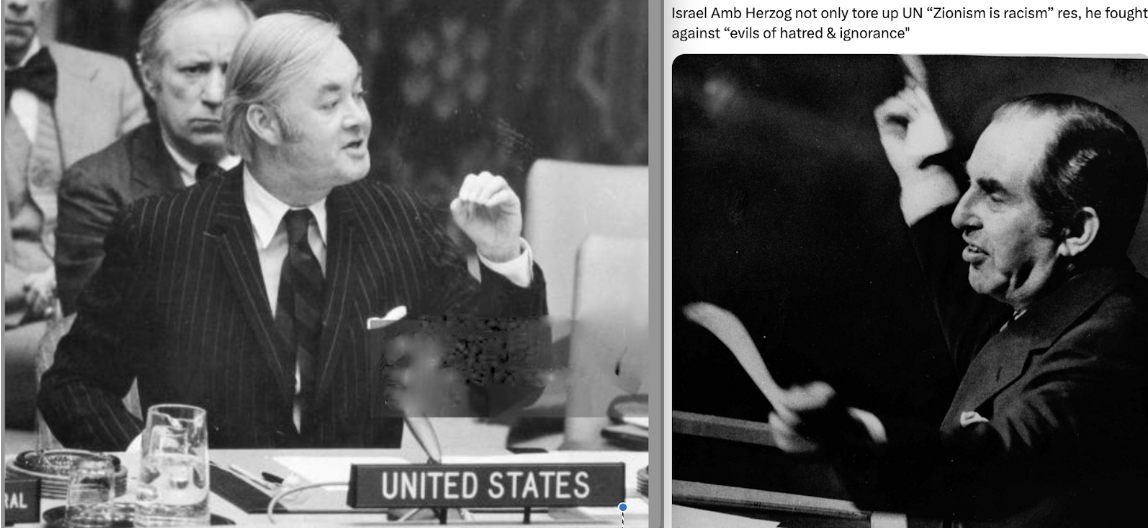
"Chaim Herzog, the man who did represent Israel, had been born in Ireland, son of the Chief Rabbi of Ireland. He had served in the Guards Armoured Division and was knighted. He was a man to be in a tank battle with; yet there was part of him that made him publisher of the Encyclopedia Judaica. A man of courage and grace, and great heart. Warrior, diplomat, statesman, he was one of our era's great Irishmen who embodied his beloved Talmud's description of one who is 'blessed with temporal greatness and spiritual strength.’”
Chaim's wife, Aura Herzog, years later recalled; "They got on like a house on fire. The Irish stick by the Irish. Chaim was proud of what Pat did for Israel, proud of fighting anti-Semitism. Pat would joking define anti-Semitism as 'hating Jews more than absolutely necessary.'"
Chaim calls Pat to ask if he understands the importance of the resolution, Pat replies that he does. Pat replies: “as we are certain to lose the vote, it is essential that we win the argument.” Pat confronts delegates and mobilizes American public opinion against the Resolution 3379 - and the UN - in two climactic moments.
October 16, 1975. Resolution 3379 is passed in the UN’s Third Committee, the Human Rights Committee. In an impassioned speech, Len Garment declares; “I choose my words carefully when I say that this is an obscene act. The language of this resolution distorts and perverts. It destroys the moral force of the concept of racism, making it an epithet to be flung arbitrarily at one’s adversary. By equating Zionism with racism, this resolution discredits the good faith of our joint efforts to fight actual racism. It discredits these efforts morally and it cripples them politically…Let us make no mistake: at risk today is the moral authority which is the United Nations’ only ultimate claim for the support of our peoples.”
October 17th, 1975. The committee room grows hot, crowded, excited. Pat and Chaim’s effort to postpone the vote fails. Herzog rises to speak; “Mr. Chairman, we have listened to the most unbelievable nonsense on the subject of Zionism from countries who are the archetypes of racists. I ask, you, does this not beg the question? Here is one small country, a free democratic country which can be visited by anybody in which all citizens, Jews and Arabs, are free and equal. Why pick on a small Jewish state? I suspect it is because it is Jewish and small.
"It doesn't surprise me, Sir, because we are a people who have lived with this form of discrimination - anti-Semitism - for centuries. This is a sad day for the United Nations. We shall not forget those who stood up for decency and civilization; and I thank the delegations who expressed themselves against this pernicious resolution. We shall not forget those who voted to attack our religion and our faith. We shall never forget.”
Pat writes in “A Dangerous Place”; “These last words were shouted, and the room for a moment fell silent. Then, as if the others were rallying their ranks, the stirring commenced again, rising to a frenzy. The vote came, racing across the computer screen. 70 in favor, 29 against, with 27 abstentions. A long, mocking applause broke out. The Israeli delegation, clearly on instructions, showed not the least emotion.
“I rose, walked over to Herzog and embraced him. 'Fuck ‘em!” I said.'”
Herzog describes the scene in his memoir; "As our delegation gathered up its papers, Pat got up, the blood rushing to his face. He straightened his tie and buttoned his jacket. I rose to greet him. He took my hand, pulled me to him and embraced me in front of the entire hall. I was very moved indeed."
Pat and Chaim walk out of the UN and head to the Four Provinces, a dank, smoke-filled Irish bar near the Waldorf. In confusion, the press corps races through the Waldorf Astoria, where the United Nations Ball is under way. Pat writes that “Secretary General Waldheim waltzed with imperial éclat.”
Pat decides to shame the countries that voted for the resolution, and to make the case that the vote was divided between dictatorships and democracies. Tip O’Neil and Jacob Javits give orations in the US congress in support of Pat’s actions. Pat appears on Face the Nation, saying: “We will stand with the rights of a liberal democracy. We will stand against that hideous thing.”
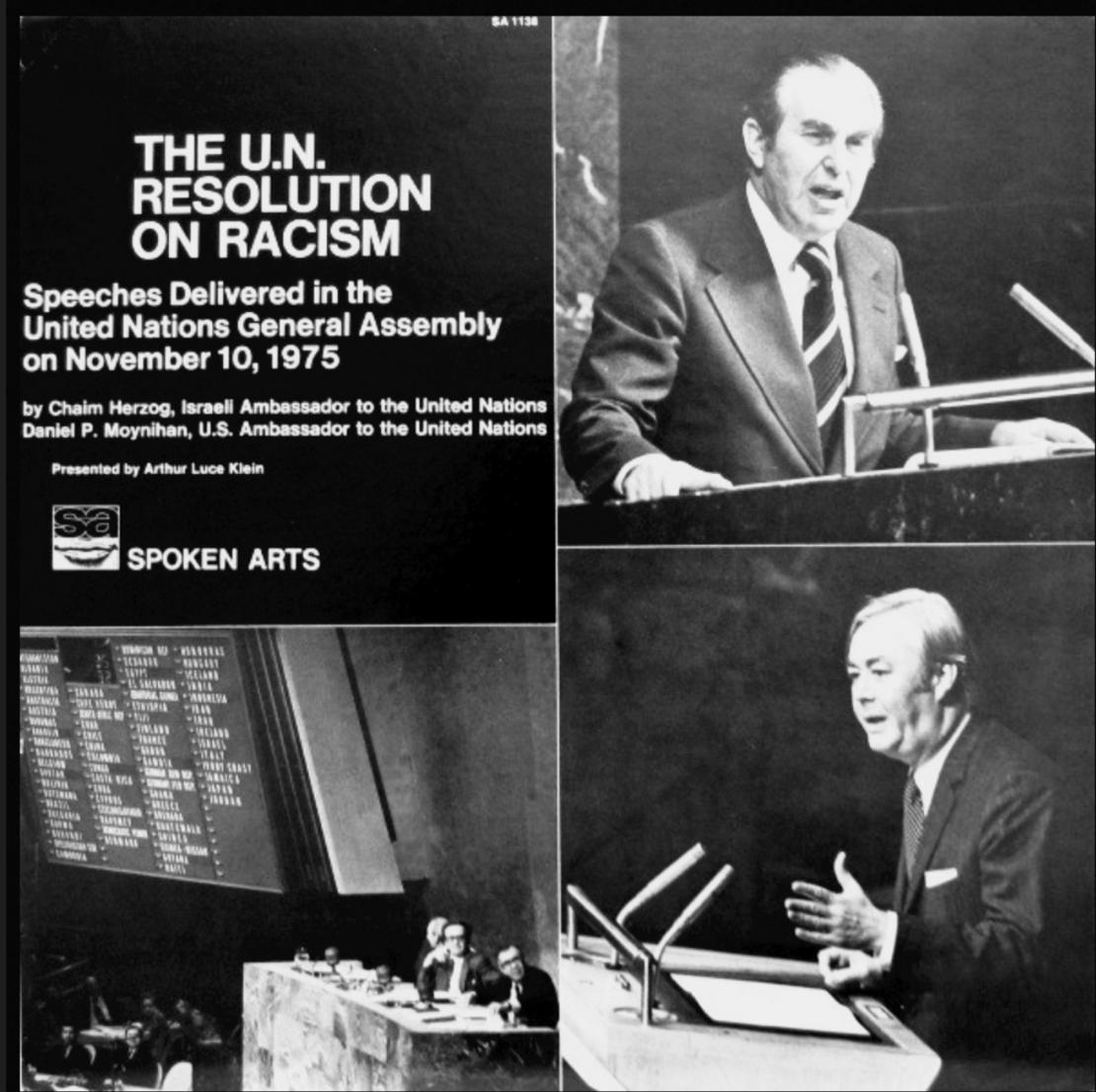
Link to full text and audio of Amb. Herzog and Amb. Moynihan's speeches https://www.americanrhetoric.com/speeches/danielpatrickmoynihanun3379.htm
November 10, 1975. The General Assembly prepares to vote on Resolution 3379. Amb. Herzog speaks before the vote; "It is symbolic that this debate should take place on November 10th. Tonight, 37 years ago has gone down in history as Kristallnacht, or The Night of the Crystals. This was the night on November 10th, 1938, when Hitler's Nazi storm troopers launched a coordinated attack on the Jewish community in Germany, burnt the synagogues in all its cities, made bonfires in the streets of the Holy Books and Scrolls, of the Holy Law and Bible. It was the night when Jewish homes were attacked and heads of families taken away, many of them never to return. It was the night when the windows of all Jewish businesses and stores were smashed, covering the streets in the cities of Germany with a film of broken glass which dissolved into millions of crystals, giving that night the name Kristallnacht, The Night of the Crystals. It was the night which led to the crematoria and gas chambers, Auschwitz, Birkenau, Dachau, Buchenwald, Theresienstadt. It was the night that led to the most terrifying holocaust in the history of man.
"It is indeed befitting, Mr. President, that the United Nations, which began its life as an anti-Nazi alliance, should 30 years later find itself on its way to becoming the world center of anti-Semitism. Hitler would have felt at home on a number of occasions during the past year, listening to the proceedings in this forum, and above all to the proceedings during the debate on Zionism.
"It is a sobering reflection indeed to consider to what this body has been dragged down if we are obliged today to contemplate an attack on Zionism. For this attack constitutes not only an anti-Semitic attack of the foulest type, but also an attack, in this world body, on Judaism, one of the oldest established religions in the world -- a religion which has given the world the human values of the Bible; a religion from which two other great religions, Christianity and Islam, sprang.
"I do not come to this rostrum to defend the moral and historic values of the Jewish people. They do not need to be defended. They speak for themselves. They have given to mankind much of what is great and eternal. They have done for the spirit of man more than can readily be appreciated by a forum such as this one.
"I come here to denounce the two great evils which menace society in general and a society of nations in particular. These two evils are hatred and ignorance. These two evils are the motivating force behind the proponents of this resolution and their supporters. These two evils characterize those who would drag this world organization, the idea of which was first conceived by the prophets of Israel, to the depths to which it has been dragged today.
"You dare talk of racism when I can point with pride to the Arab Ministers who have served in my Government; to the Arab deputy speaker of my Parliament; to Arab officers and men serving of their own volition in our defense, border, and police forces, frequently commanding Jewish troops; to the hundreds of thousands of Arabs from all over the Middle East crowding the cities of Israel every year; to the peaceful coexistence which has developed; to the fact that Arabic is an official language in Israel on a par with Hebrew; to the fact that it is as natural for an Arab to serve in public office in Israel as it is incongruous to think of a Jew serving in any public office in any Arab country, indeed being admitted to many of them.
"Over the centuries it has fallen to the lot of my people to be the testing agent of human decency, the touchstone of civilization, the crucible in which enduring human values are to be tested. A nation's level of humanity could invariably be judged by its behavior towards its Jewish population. It always began with the Jews but never ended with them. This wicked resolution must sound the alarm for all decent people in the world. The Jewish people, as a testing agent, has unfortunately never erred. The implications inherent in this shameful move are terrifying indeed.
"The vote of each delegation will record in history its country's stand on anti-Semitic racism and anti-Judaism. You yourselves bear the responsibility for your stand before history, for as such will you be viewed in history. But we, the Jewish people, will not forget.
"For us, the Jewish people, this is but a passing episode in a rich and event-filled history. We put our trust in our Providence, in our faith and beliefs, in our time-hallowed tradition, in our striving for social advance and human values, and in our people wherever they may be.
"For us, the Jewish people, this resolution, based on hatred, falsehood and arrogance, is devoid of any moral or legal value. For us, the Jewish people, this is no more than a piece of paper, and we shall treat it as such."
Amb. Herzog tears apart the resolution, as in 1935 his father had torn apart the British White Paper limiting Jewish immigration to Palestine.
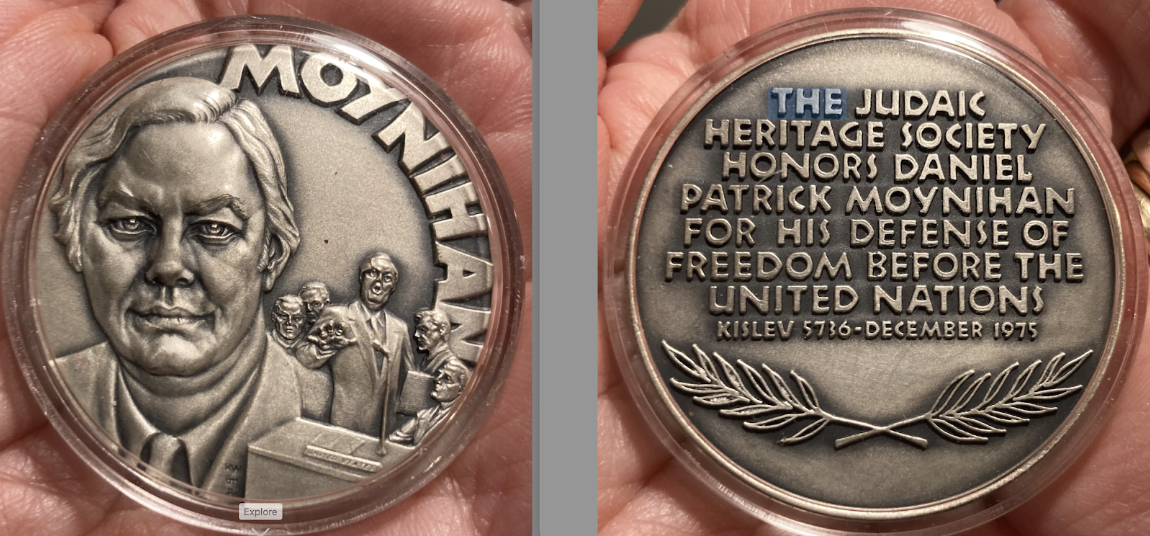
The UN General Assembly passes Resolution 3379. Pat ascends to the podium:
"The United States rises to declare before the General Assembly of the United Nations, and before the world, that it does not acknowledge, it will not abide by, it will never acquiesce in this infamous act.
"Not three weeks ago, the United States Representative in the Social, Humanitarian, and Cultural Committee pleaded in measured and fully considered terms for the United Nations not to do this thing. It was, he said, 'obscene.' It is something more today, for the furtiveness with which this obscenity first appeared among us has been replaced by a shameless openness.
"There will be time enough to contemplate the harm this act will have done the United Nations. Historians will do that for us, and it is sufficient for the moment only to note the foreboding fact. A great evil has been loosed upon the world. The abomination of anti-Semitism - as this year’s Nobel Peace Laureate Andrei Sakharov observed in Moscow just a few days ago - has been given the appearance of international sanction. The General Assembly today grants symbolic amnesty - and more - to the murderers of the six million European Jews. Evil enough in itself, but more ominous by far is the realization that now presses upon us - the realization that if there were no General Assembly, this could never have happened.
"As this day will live in infamy, it behooves those who sought to avert it to declare their thoughts so that historians will know that we fought here, that we were not small in number - not this time - and that while we lost, we fought with full knowledge of what indeed would be lost. The proposition to be sanctioned by a resolution of the General Assembly of the United Nations is that 'Zionism is a form of racism and racial discrimination.' Now this is a lie. But as it is a lie which the United Nations has now declared to be a truth, the actual truth must be restated.
"The very first point to be made is that the United Nations has declared Zionism to be racism - without ever having defined racism. 'Sentence first - verdict afterwards' as the Queen of Hearts said. But this is not wonderland, but a real world, where there are real consequences to folly and to venality.
"Lest I be unclear, the United Nations has in fact on several occasions defined 'racial discrimination.' The definitions have been loose, but recognizable. Indeed, the term has only recently appeared in the United Nations General Assembly documents. The one occasion on which we know the meaning to have been discussed was the meeting of the Third Committee on December 16, 1968, in connection with the report of the Secretary-General on the status of the international convention on the elimination of all racial discrimination. On that occasion - to give some feeling for the intellectual precision with which the matter was being treated - the question arose, as to what should be the relative positioning of the terms “racism” and 'Nazism' in a number of the 'preambular paragraphs.' The distinguished delegate from Tunisia argued that 'racism' should go first because “Nazism was merely a form of racism.' Not so, said the no less distinguished delegate from the USSR. For, he explained, 'Nazism contained the main elements of racism within its ambit and should be mentioned first.' This is to say that racism was merely a form of Nazism.
"The discussion wound to its weary and inconclusive end, and we are left with nothing to guide us for even this one discussion of 'racism' confined itself to world orders in preambular paragraphs and did not at all touch on the meaning of the words as such. Still, one cannot but ponder the situation we have made for ourselves in the context of the Soviet statement on that not so distant occasion. If, as the distinguished delegate declared, racism is a form of Nazism - and if, as this resolution declares, Zionism is a form of racism - then we have step to step taken ourselves to the point of proclaiming -the United Nations is solemnly proclaiming - that Zionism is a form of Nazism.
"What we have here is a lie - a political lie of a variety well known to the twentieth century and scarcely exceeded in all that annal of untruth and outrage. The lie is that Zionism is a form of racism. The overwhelmingly clear truth is that is it not. The word 'racism' is a creation of the English language, and relatively new to it. It is not, for instance, to be found in the Oxford English Dictionary (appears in 1982 supplement to Oxford Dictionary). The term derives from relatively new doctrines - all of them discredited - concerning the human population of the world, to the effect that there are significant biological differences among clearly identifiable groups, and that these differences establish, in effect, different levels of humanity. Racism, as defined in Webster’s Third New International Dictionary, is 'The Assumption that traits and capacities are determined by biological race and that races differ decisively from one another.' It further involves 'a belief in the inherent superiority of a particular race and its right to dominate over others'.”
"This meaning is clear. It is equally clear that this assumption, this belief, has always been altogether alien to the political and religious movement known as Zionism. As a strictly political movement, Zionism was established only in 1897, but the modern Zionism movement arose in Europe in the context of a general upsurge of national consciousness and aspiration that overtook most other people of Central and Eastern Europe after 1848, and that in time spread to all of Africa and Asia. It was, to those persons of the Jewish religion, a Jewish form of what today is called a national liberation movement.
"Now it was the singular nature - if, I am not mistaken, it was the unique nature - of this national liberation movement that in contrast with the movements that preceded it, those of that time, and those that have come since, it defined its members in terms not of birth, but of belief. Zionists defined themselves merely as Jews and declared to be Jewish anyone born of a Jewish mother or - and this is the absolutely crucial fact - anyone who converted to Judaism. Which is to say, in terms of International Convention on the Elimination of All Forms of Racial Discrimination, adopted by the 20th General Assembly, anyone — regardless of 'race, colour, descent, or nationally or ethnic origin'.”
"The state of Israel, which in time was the creation of the Zionist Movement, has been extraordinary in nothing so much as the range of 'racial stocks' from which it Orient and Jew from the West. The population of Israel also includes large numbers of non-Jews, among them Arabs of both the Muslim and Christian religions and Christians of other national origins. Many of these persons are citizens of Israel, and those who are not can become citizens by legal procedures very much like those which obtain in a typical nation of Western Europe.
"Now I should wish to be understood that I am here making one point, and one point only, which is that whatever else Zionism may be, it is not and cannot be 'a form of racism.' In logic, the State of Israel could be, or could become, many things, theoretically, including many things undesirable, but it could not be and could not become racism unless it ceased to be Zionist.
"Indeed, the idea that Jews are a “race” was invented not by Jews but by those who hated Jews. The idea of Jews as a race was invented by 19th century anti-Semites such as Houston Steward Chamberlain and Edouard Drumont, who saw that in an increasingly secular age, which is to say an age made for fewer distinctions between people, the old religions grounds for anti-Semitism were losing force. New justifications were needed for excluding and persecuting Jews, and so the new idea of Jews as a race - rather than as a religion - was born. It was a contemptible idea at the beginning, and no civilized person would be associated with it. To think that it is an idea now endorsed by the United Nations is to reflect on what civilization has come to.
"It is precisely a concern for civilization, for civilized values that are or should be precious to all mankind, that arouses us at this moment to such special passion. What we have at stake here is not merely the honor and the legitimacy of the State of Israel — although a challenge to the legitimacy of any member nation ought always to arouse the vigilance of all members of the United Nations. For a yet more important matter is at issue, which is the integrity of the whole body of moral and legal precepts which we know as human rights.
"The terrible lie that has been told here today will have terrible consequences. Not only will people begin to say, indeed they have already begun to say that the United Nations is a place where lies are told, but far more serious, grave and perhaps irreparable harm will be done to the cause of human rights itself. The harm will arise first because it will strip from racism the precise and abhorrent meaning that it still precariously holds today. How will the people of the world feel about racism and the need to struggle against it, when they are told that it is an idea as broad as to include the Jewish national liberation movement?
"As the lie spreads, it will do harm in a second way. Many of the members of the United Nations owe their independence in no small part to the notion of human rights, as it has spread from the domestic sphere to the international sphere exercised its influence over the old colonial powers. There will be new forces, some of them arising now, new prophets and new despots, who will justify their actions with the help of just such distortions of words as we have sanctioned here today. Today we have drained the word 'racism' of its meaning. Tomorrow, terms like 'national self-determination' and 'national honor' will be perverted in the same way to serve the purposes of conquest and exploitation. And how will the small nations of the world defend themselves, on what grounds will others be moved to defend and protect them, when the language of human rights, the only language by which the small can be defended, is no longer believed and no longer has a power of its own?
"There is this danger, and then a final danger that is the most serious of all. Which is that the damage we now do to the idea of human rights and the language of human rights could well be irreversible. The idea of human rights as we know it today is not an idea which has always existed in human affairs, it is an idea which appeared at a specific time in the world, and under very special circumstances. It appeared when European philosophers of the seventeenth century began to argue that man was a being whose existence was independent from that of the State, that he need join a political community only if he did not lose by that association more than he gained. From this very specific political philosophy stemmed the idea of political rights, of claims that the individual could justly make against the state; it was because the individual was seen as so separate from the State that he could make legitimate demands upon it.
"That was the philosophy from which the idea of domestic and international rights sprang. But most of the world does not hold with that philosophy now. Most of the world believes in newer modes of political thought, in philosophies that do not accept the individual as distinct from and prior to the State, in philosophies that therefore do not provide any justification for the idea of human rights and philosophies that have no words by which to explain their value. If we destroy the words that were given to us by past centuries, we will not have words to replace them, for philosophy today has no such words.
"But there are those of us who have not forsaken these older words, still so new to much of the world. Not forsaken them now, not here, not anywhere, not ever.
"The United States of America declares that it does not acknowledge, it will not abide by, it will never acquiesce in this infamous act."
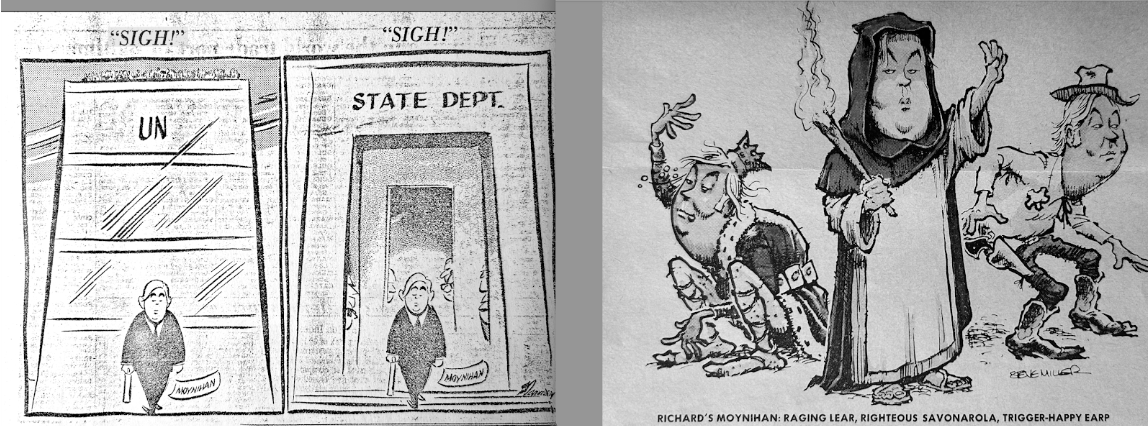
On that same day, Kissinger says to one of his aides, “We are conducting foreign policy, this is not a synagogue,” and they joke whether the Irish-Catholic Moynihan wants to convert to Judaism.
Kissinger speaks condescendingly of Pat in a press conference; “Ambassador Moynihan makes so many remarks in the course of a day, it is not easy to keep up with all of them.” The NY Times headlines reads; “Kissinger Warns of Haste on UN: Assails Zionism Resolution but Cautions Against Any ‘Extreme’ Reactions.”
Pat tells Liz that Kissinger is trying to undermine him, and he has no choice but resign. But President Ford tells Pat that he will not accept his resignation, and so once again, Pat agrees to stay in Turtle Bay.
November 12, 1975. Pat and Kissinger attend a White House dinner for the Luxembourg Prime Minister. Kissinger is pleasant. But five days later, Newsweek reports; “Kissinger raked Moynihan over the coals for his behavior at the UN. Some western diplomats complained about Moynihan’s outspoken performance. Moynihan insisted that he had acted properly. 'Did I make a crisis out of this obscene resolution?' stormed the US ambassador. 'Damn right I did!'”
Pat, Len, Clarence and Suzi continue to push the theme of human rights, by introducing a resolution appealing to governments to grant general amnesty for all political prisoners. The effort is assailed by certain elite American commentators and gains no support from western Europeans.
The night the amnesty resolution is introduced, Pat meets a German journalist who tells him; “The news of what the USA has proposed will be whispered from cell to cell in East German prisons. You would think such news would never reach such places, but it does: it is what keeps you alive. I know. I spent four years in one of them.”
The British Ambassador to the UN, Ivor Richards, denounces Pat in a speech. The press notes this surprising riff between the two allies, the United States and the United Kingdom. The New York Times headline: "Moynihan’s Style at the UN Now an Open Issue.” The Washington Post headline: “UN Chic” defends Pat for his defense of language and forcing the UN to define “racism.” In his column in the New York Times “Henry & Pat & Ivor” Bill Safire writes that Kissinger’s “campaign to undercut Moynihan lacks surgical skill.”
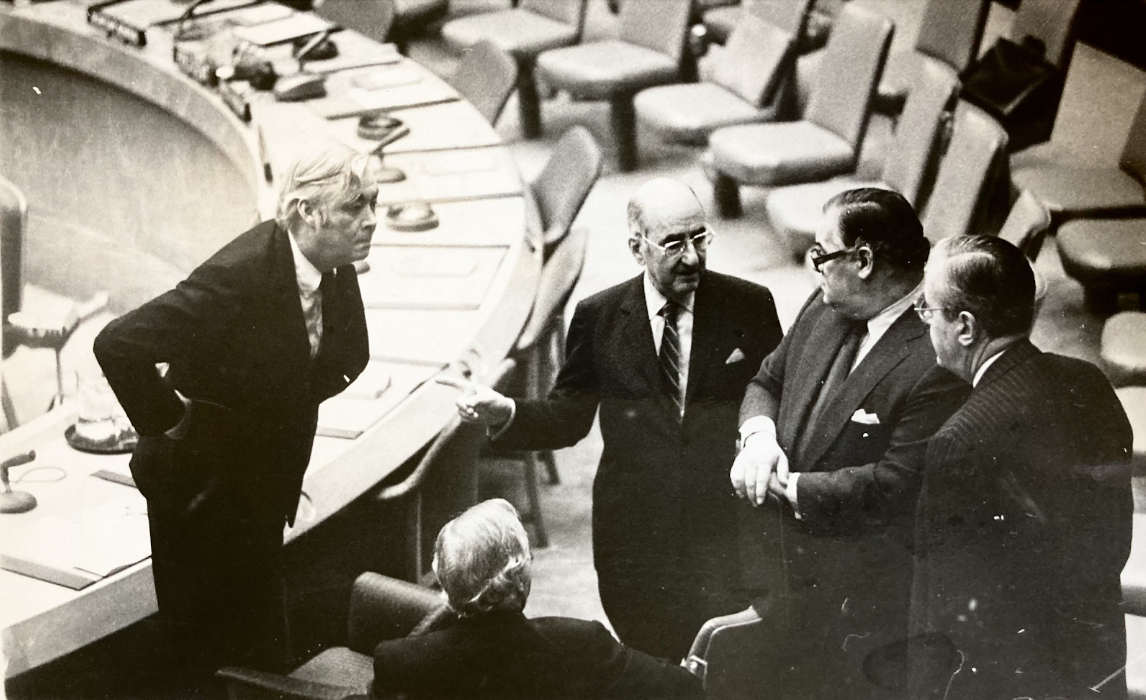
Pat confronts UK Amb. to the UN Ivor Richards, 2nd from right
Pat suspects that this is Kissinger’s plot. During dinner at the residence of the Iranian Ambassador, Pat approaches Richards to say, there were people at US Mission who thought his speech represented official British policy. Quite right, says Ivor. This confirms that Kissinger was behind Amb. Richards’s attack on Pat.
Once more, Pat tells Liz that he is being undermined by Kissinger and therefore must resign. Pat flies to Washington to meet with President Ford in the Oval Office. Ford assures Pat of his support and persuades Pat to stay at the UN.
Pat hosts a press conference at the UN with Garment, an Eastern European Jew, US Rep. Don Fraser, a Midwestern WASP, Clarence Mitchell, an African American NAACP activist, to create a tableau of all-American diversity, denouncing the Zionism is Racism resolution. The next day, over 125,000 people join a rally in mid-Manhattan denouncing the resolution, condemning the UN and cheering Amb. Moynihan. Bayard Rustin, Martin Luther King’s friend and ally, looks at the crowd and sings out “When Israel was in Egypt’s Land,” and leads an all-American chorus, black and white, Jew and non-Jew, left and right shouting together; “LET MY PEOPLE GO.”
December 11th, 1975: At the end of the Thirtieth Assembly, Soviet Ambassador to the UN, Yakov Malik, asks to speak with Pat, alone, in the delegates lounge. Malik is furious that Pat gave a speech quoting Andrei Sakharov, the Russian Scientist who had just been awarded the 1975 Nobel Peace Prize. He asks Pat to leave out the Sakharov quote in his upcoming speech. Pat replies “you will see what I will do.”
Pat reads the Sakharov quote; “The struggle for a general political amnesty is the struggle for the future of mankind.” Ambassador Malik storms out of the General Assembly. Pat smiles, for once, the Soviets have quit the field. Pat decides to give up tenure at Harvard to continue his work at the UN.
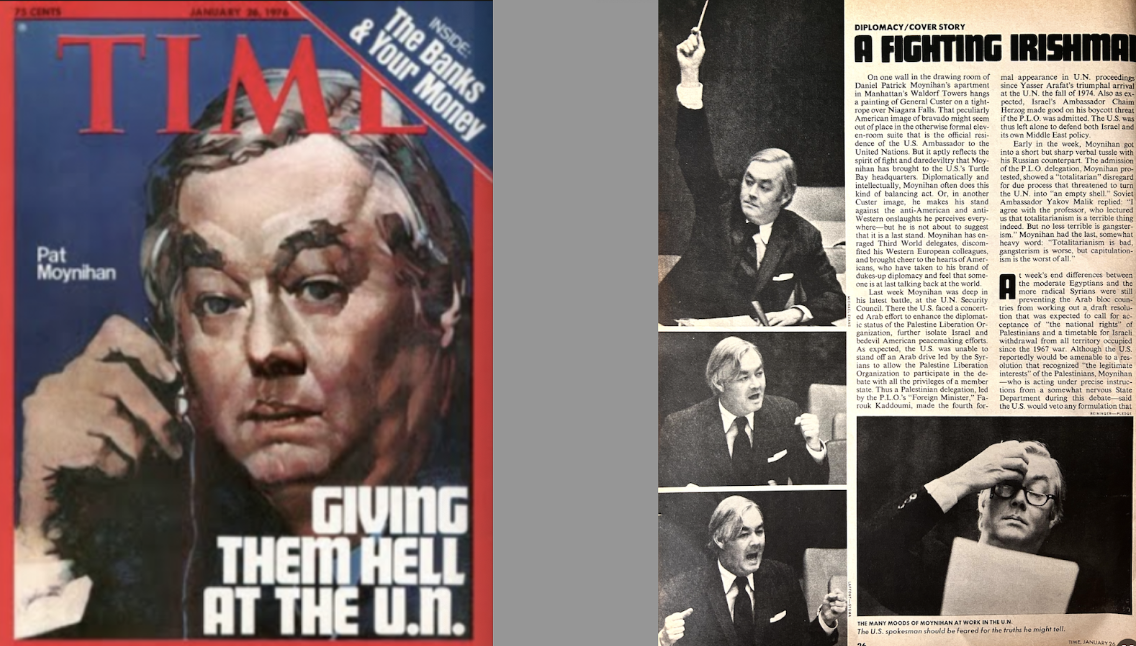
January 26th, 1976. Pat is on the cover of Time magazine “Giving Them Hell at the UN.” Cab drivers honk as he walks to work, shouting “attaboy Pat!” Pat and Norman Podhoretz attend a concert at Carnegie Hall and receive a standing ovation. The US Mission to the UN receives more mail than at any times since the Cuban Missile Crisis, with the letters 80 to 1 in favor of Pat.
One of Pat’s State Department cables is leaked to the New York Times, with the headline “Moynihan says State Department Fails to Back Policy Against US Foes in the UN.” At midnight, the New York Times arrives at the ambassador’s residence at the Waldorf, the Scotty Reston column is entitled; “What About Moynihan?” Reston writes “Ford and Kissinger support him in public but deplore him in private.”
Russell Baker comes to Pat’s defense in his NY Times column; “Moynihan spoke English, an ancient tongue which, though long fallen into disuse, still has the power to sway men’s minds, and upon arrival at the United Nations, he outraged all humanity by speaking it aloud.” Baker also asks; “who leaked the memo and why?”
Pat sits as his desk and composes his letter of resignation for President Ford. This time, the president accepts it.
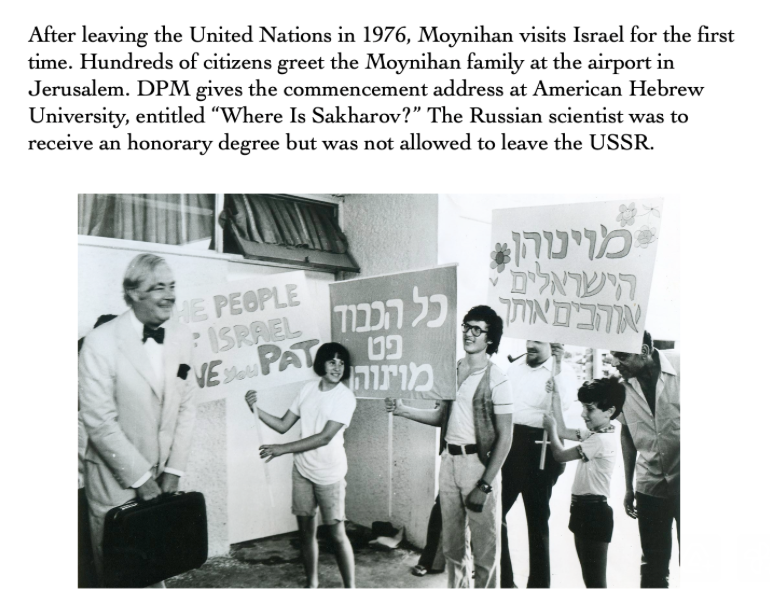
After eight months at the UN, Pat and Liz host a final dinner with friends at the envoy's residence on the 42nd floor of the Waldorf Astoria. They return to Cambridge, Pat resumes teaching at Harvard. It is 1976, and there is a senate race in New York state. Dick Ravitch, Len Garment and Norman Podhoretz urge Pat to enter the Democratic primary. There are already four candidates in the race, the front runner is Manhattan Congresswoman Bella Abzug. Pat enters in late June, with no campaign staff or funds. In July the Moynihans fly to Jerusalem, where Pat and Liz reunite with Chaim and Aura Herzog, and Israel celebrates the Entebbe Rescue.
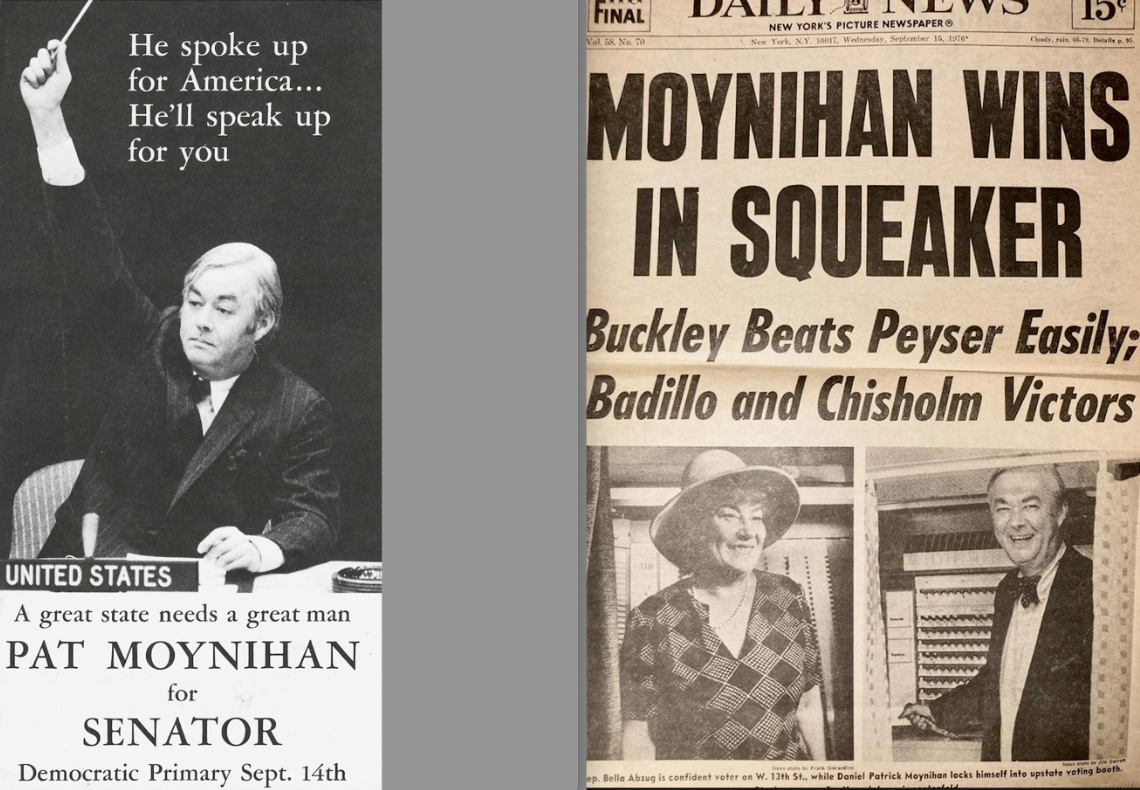
September 14th, 1976, Pat wins the New York State Democratic Senate Primary by what he calls “a whopping 1%.” In November he defeats James Buckley in a notably civil campaign, and they remain friends throughout Pat’s 24 years in the Senate. Pat receives a $1000 campaign contribution from a woman who writes that she will double it if he would cease his efforts to overturn Resolution 3379. Pat returns the check, writing “No one is going to dictate to me my conscience.”
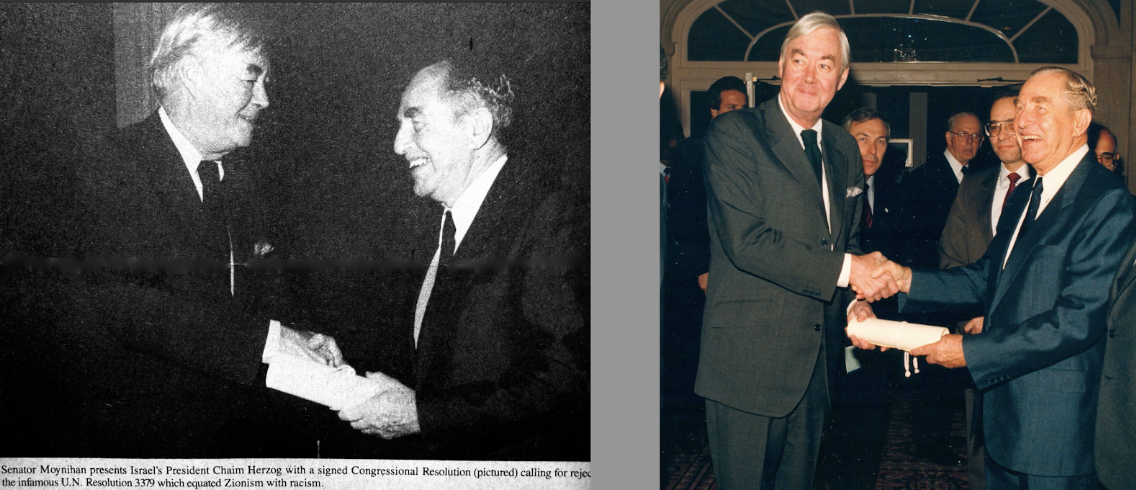
In the 16 years between the passage of Resolution 3379 and its repeal in 1991, Pat gives 750 speeches about the UN's vilification of Israel. On November 13th, 1987, Pat gives an address at the Plaza Hotel in New York entitled “Days of Infamy, Days of Hope: This past November 10th, Chaim Herzog, now president of the state of Israel, returned to these shores to address the US Congress the great achievements of the state of Israel in the 40 years since its founding, and not least since the Zionism resolution. For neither Israel, nor Zionism, nor democracy was dishonored by that event. The United Nations was dishonored. And it has had no such luck since. It has ever since been on a downward path to inconsequence, if not extinction. The world can turn again. And the United Nations can return to the principles on which it was founded. Let us come to the 43rd General Assembly with a single united purpose. Overturn the Zionism resolution.”
On December 16, 1991, UN Resolution 3379 is repealed by 111 votes in favor, 25 votes against, and 13 abstentions. Pat and Chaim sit together in the visitor’s gallery and celebrate afterwards, with friends and Guiness.
My mother Liz passed away in Manhattan, aged 94, on Nov. 7th, 2023, which, fittingly, was election day, as Liz was campaign manager for Pat's New York senate campaigns, winning landslide victories on shoestring budgets. Liz watched the slaughter in Israel on October 7th, 2023, in horror; Chaim's widow Aura Herzog was one of Liz's dearest friends, Liz visited Israel many times and had deep bonds to the Jewish community of New York. Liz was especially shocked and repulsed by teachers and students at our once-prestigious New York universities hoisting signs that read; “Gas the Jews” “Hitler Was Right” and “Zionism is Racism.”
In September 2023, I boycotted the opening of the CCNY Moynihan Center to protest this institutional normalization of anti-Semitism. I asked CCNY faculty and administrators and Ms. Shelby White, trustee of the Leon Levy Foundation who donated $6 million to The Moynihan Center, if they would make a public statement denouncing the demonization of Jews and Israel at CCNY. All refused. Such rank cowardice - and deafening silence- in the face of these dangerous anti-American and anti-Semitic ideologies is capitulation to and collusion with those ideologies, which Pat and Liz condemned throughout their lives.
"There is only one political poem of the twentieth century I consider worth remembering, and that is Yeats’s ‘Parnell.’
Parnell came down the road, he said to a cheering man:
“Ireland shall get her freedom, and you shall still break stone.”
This is the knowledge life gives us, and it is indispensable to politics. And yet how alien to it."Daniel Patrick Moynihan